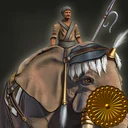
Cavalry · Fortress Age
Mansabdar Mahout
Mansabdar Mahout (proto ID ypMahoutMansabdar) is a cavalry unit in AoE3: Definitive Edition 100.19.18309 from the Fortress Age: 1,834 hit points, melee 28 every 1.5 s (×2 vs Infantry), 30% ranged resist. It costs 800 food, 500 wood and takes 60 s to train at the Charminar Gate. 1 civilization has it.
Quick answers (3)
- How much does Mansabdar Mahout cost in AoE3?
- 800 food, 500 wood; 60 s to train; 7 population (AoE3: Definitive Edition 100.19.18309).
- Which civilizations have Mansabdar Mahout?
- Indians.
- What is the proto ID of Mansabdar Mahout?
- ypMahoutMansabdar — the name scenario triggers, AI scripts and mods use.
 800
800 500
500Inspires all nearby Mahout Lancers. Heavy hand cavalry that does wide area damage. Exceptionally deadly against archers and skirmishers.
- Population
- 7
- Line of sight
- 15
- Ranged resist
- 30%
- Build limit
- 1
- Available from
- IIIFortress
- XP when killed
- 130
- Game ID
ypMahoutMansabdar
In the game's words
How to use it
The Mansabdar Mahout Lancer is an Elite Indian unit that can be trained at the Charminar Gate Wonder. It has an inspiring affect on all nearby non-Mansabdar units of the same type, increasing their attack and hitpoints. The Mahout Lancer is an Indian melee cavalry unit that moves faster than any other elephant. It is extremely resilient, able to move in close to infantry and fight for long periods without depleting its high number of hitpoints. Its trample attack inflicts great area damage against infantry.
History
During his rule over the Mughal Empire of India, Akbar the Great brought the whole of his military organization under a new system of administration called the mansabdari. The title was taken from the term “mansab,” which means rank. Officers in the Mughal army were given a mansab and then expected to be servants of the state, with their dismissal or suspension resting directly in the hands of the emperor. There were thirty-three grades of mansabdars, differentiated by the Zat and the Sawar. The Zat referred to the number of troops that the mansabdar maintained, while the Sawar referred to the number of horses that he maintained. The number of soldiers under a man’s command could start at ten and rise into the ten thousands. Of course, the highest rank that any common officer could hold only offered a command of 5,000 men. Larger forces were always first allotted to royal princes. Yet, after the death of Akbar at the beginning of the seventeenth century, the grades were increased. Common officers could reach the mansabdar grade corresponding to a command of over 20,000 men. Mahout is the traditional name for one who trains and handles a domesticated elephant, a practice that has occurred for more than 3,000 years. In Hindu culture, elephants were highly respected as a manifestation of the elephant god Ganesh, the god of good luck. Having elephants participate in a festival or procession was required for every celebratory occasion, and being the mahout who cared for a great elephant on such an occasion was a great honor. Often considered the natural predecessor of the modern-day tank, the elephant brought many unique elements to its role as a battlefield unit. Early successes had more to do with surprise and intimidation than battlefield effectiveness. Enemy horses or camels, whether frightened by the beast’s smell, or overwhelmed by its sheer size, proved powerless against the elephant. It trampled oncoming waves of infantry and knocked riders from their mounts, scattering ranks and causing general confusion. It had a similar effect on the human enemy, terrifying many men to the point of panic. Yet, as armies became more accustomed to fighting elephants in battle, the methods of how to defeat them became evident. The most famous event involving a triumph over elephants occurred in 1398, when the Mongol conqueror Timur invaded India to overthrow the Delhi Sultanate. At a loss for how to fight back against the Indian’s elephants, Timur prayed to Allah for guidance. Then, according to legend, he attached straw to the backs of the camels in his army and sent them out to fight. When the camels neared the elephants, Timur had his men ignite the straw. The sight of the stampeding, flaming camels spooked the elephants so badly that they ended up crushing many Indian troops in their rush to escape.
From the game's History encyclopedia (Special).

Attacks
| Attack | Damage | Every | Range | Multipliers |
|---|---|---|---|---|
| Meleearea 2 | 28 melee | 1.5 s | — | ×0.5 vs Heavy Infantry×2 vs Infantry |
| Siege | 100 siege | 3 s | — | — |
| Tramplearea 3 | 20 melee | 2 s | — | ×0.5 vs Heavy Infantry×2 vs Infantry |
Trained at
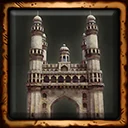
Civilizations

Cards and technologies that change it
 Foreign Trading CompaniesFood cost +2%, Wood cost +2%
 Mughal Elephant Armorshand resist +0.1
 Cavalry CuirassHeavy Cavalry: hit points +10%
 TEAM Cavalry AttackHeavy Cavalry: damage +10%TEAM Cavalry AttackHeavy Cavalry: damage +10%
 BlandenguesHand Cavalry: Coin cost −20%, Wood cost −20%, Food cost −20%
 Hand Cavalry AttackHand Cavalry: damage +15%
 Hand Cavalry HitpointsHand Cavalry: hit points +15%
 Hand Infantry / Hand Cavalry HitpointsHand Cavalry: hit points +15%
 Junín HussarsHand Cavalry: train time −30%; Cavalry: speed +5%
 Morning StarHand Cavalry: damage bonus against Guardian +2
 PancerzHand Cavalry: ranged resist +0.1
 PillageHand Cavalry: damage bonus against Building +25%
 Plan of Casa MataHand Cavalry: speed +5%TEAM Hand Cavalry AttackHand Cavalry: damage +15%
 Crushing ForceElephant: damage (Melee) +15%, damage (Melee (defend)) +15%, damage (Trample) +15%
 Elephant CombatElephant: hit points +20%, damage +20%
 Tame ElephantsElephant: Coin cost −10%, Wood cost −10%, Food cost −10%, train time −10%
 Exalted Mahout LancerMahout: hit points +50%, damage +50%
 Honored Mahout LancerMahout: damage +30%, hit points +30%
 Professional HandlersMahout: population −1
 Cavalry CombatCavalry: hit points +15%, damage +15%Cavalry CombatCavalry: damage +15%, hit points +15%Cavalry CombatCavalry: hit points +15%, damage +15%Cavalry CombatCavalry: hit points +15%, damage +15%Cavalry CombatCavalry: hit points +15%, damage +15%Cavalry CombatCavalry: hit points +15%, damage +15%Cavalry CombatCavalry: hit points +15%, damage +15%Cavalry CombatCavalry: hit points +15%, damage +15%Cavalry CombatCavalry: hit points +15%, damage +15%Cavalry CombatCavalry: hit points +15%, damage +15%Cavalry DamageCavalry: damage +15%Cavalry DamageCavalry: damage +15%Cavalry HitpointsCavalry: hit points +15%Cavalry HitpointsCavalry: hit points +15%
 CouriersCavalry: train time −45%
 Horse SecretsCavalry: speed +10%, train time −35%HorsemanshipCavalry: train time −33%, damage bonus against Walls +1
 Liberation MarchCavalry: train time −35%, speed +5%
…and 36 more that change every Heavy Cavalry.
Source: protoy.xml and techtreey.xml, AoE3: DE 100.19.18309 (build 25040513).