

Asian civilization · Home City Delhi
Indians
The Indians (civ ID Indians, Home City Delhi) in AoE3: Definitive Edition 100.19.18309 start with 2 Crates of Food, 4 Cords of Wood, 1 Brahmin, 1 Brahmin and 6 Hindu Villager, train 27 kinds of units from their own buildings and have 150 Home City cards. Their age-up choices number 5 / 5 / 5 / 5 for the Colonial, Fortress, Industrial and Imperial ages.
This section as JSON: /raw/civilizations.json
Quick answers (4)
- What are the Indians bonuses in AoE3?
- Civilization bonus: Most shipments will give you additional villagers. Villagers cost wood instead of food, cannot gather food from livestock. Unique units: Brahmin, Flail Elephant, Gurkha, Howdah, Mahout Lancer, Rajput, Siege Elephant, Sepoy, Sowar and Zamburak. Unique buildings: Sacred Field generates more exp when tasked with livestock and also trains cows. Mango Grove is a resource for wood. Caravanserai fulfils a similar role to stables. Wonders: Agra Fort, Charminar Gate, Karni Mata, Taj Mahal, Tower of Victory The Mughal Empire was an early-modern empire in South Asia. It was known as one of the largest empires in the history of South Asia.
- What do the Indians start with?
- 2 Crates of Food, 4 Cords of Wood, 1 Brahmin, 1 Brahmin and 6 Hindu Villager.
- Which Indians age-up gives the most?
- to the Colonial Age: Karni Mata (≈ 500 resources); to the Fortress Age: Karni Mata (≈ 1,000 resources); to the Industrial Age: Taj Mahal (≈ 1,500 resources); to the Imperial Age: Karni Mata (≈ 2,400 resources).
- How many Home City cards do the Indians have?
- 150, plus 0 more in revolution decks.
Bonuses
Civilization bonus: Most shipments will give you additional villagers. Villagers cost wood instead of food, cannot gather food from livestock. Unique units: Brahmin, Flail Elephant, Gurkha, Howdah, Mahout Lancer, Rajput, Siege Elephant, Sepoy, Sowar and Zamburak. Unique buildings: Sacred Field generates more exp when tasked with livestock and also trains cows. Mango Grove is a resource for wood. Caravanserai fulfils a similar role to stables. Wonders: Agra Fort, Charminar Gate, Karni Mata, Taj Mahal, Tower of Victory The Mughal Empire was an early-modern empire in South Asia. It was known as one of the largest empires in the history of South Asia.
The game's own civilization summary (civ picker rollover).
Starting units
- 2×
 Crates of Food
 - 4×
 Cords of Wood
 - 1×
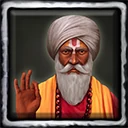 Brahmin
 - 1× Brahmin
- 6×
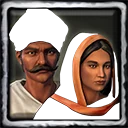 Hindu Villager
Units few others have
Units Indians train from their own buildings that no more than one other civilization has.




Age-up choices
What each choice costs and hands over, valued at the units' train cost. Compare every civilization's age-ups.
To the Colonial Age
 Karni Mata—gives ≈ 500
- Taj Mahal—gives ≈ 500
- Tower of Victory—gives ≈ 400
- Charminar Gate—gives ≈ 320
- Agra Fort—gives ≈ 240
To the Fortress Age
 Karni Mata—gives ≈ 1,000
- Taj Mahal—gives ≈ 800
- Tower of Victory—gives ≈ 800
- Charminar Gate—gives ≈ 650
- Agra Fort—gives ≈ 600
To the Industrial Age
 Taj Mahal—gives ≈ 1,500
- Karni Mata—gives ≈ 1,400
- Charminar Gate—gives ≈ 1,300
- Tower of Victory—gives ≈ 1,200
- Agra Fort—gives ≈ 840
To the Imperial Age
 Karni Mata—gives ≈ 2,400
- Taj Mahal—gives ≈ 2,400
- Tower of Victory—gives ≈ 2,000
- Charminar Gate—gives ≈ 1,950
- Agra Fort—gives ≈ 1,680
History
The fall of India’s mighty Mughal Empire coincides with the rise of British rule in the subcontinent, occurring in the 18th century; yet even as the British established control, their arrival was little more than the last blow to an already struggling native dynasty. The Mughal Empire, bastion of high culture, geographic expansion, and military might, had fallen. The Mughal Empire has its origins in neighboring Afghanistan and Turkestan, where descendents of the Mongol Empire had become Muslims and where the Muslim ruler Babur began forming the foundations of a new kingdom in 1504 with the seizure of Kabul, and territories leading east into the Indus River Valley. In 1526, he pushed further into India and defeated the last of the Delhi Sultans, Ibrahim Shah Lodi, at the First Battle of Panipat. Babur’s son Humayun succeeded him in 1530, but quickly lost most of the newly won territory. For a time he ruled in exile, but eventually raised an army large enough to march back to Delhi in 1555 and conquer it a second time. Next in the line of succession was Humayun’s son Akbar, who succeeded his father on 14 February 1556, while in the midst of a war against Sikandar Shah for the reclamation of the Mughal throne. Akbar won his first victory at the age of 13 or 14, and quickly established himself as a confident ruler who had a vision for the future of his empire. He created fair taxes, built an efficient government, placed an emphasis on high culture, and encouraged radical religious tolerance. Because of his contributions, Akbar is considered the greatest of the Mughal rulers. The Mughal Empire only lasted for another one hundred years. Its last great ruler was Aurangzeb Alangir, a zealous Muslim who abandoned the tolerance of his predecessors and began to crack down on other faiths, especially the Hindus. During his fifty-year reign, religious prejudice drove a wedge between the ruler and his subjects. Aurang’s intentions were to force the Hindus to convert. Temples were despoiled and a tax for non-Muslims was introduced. Following Aurang, the Mughal Empire suffered from a lack of powerful authority, causing regional nawabs, or governors, to split and found their own kingdoms, such as the Marathas in the south and the Sikhs in the north. The next 27 years of the Mughal Empire were spent in clashes with its neighbors, and in 1739, invading Persian and Afghan armies invaded Delhi. The greatest empire in India had crumbled and individual kingdoms rushed to gobble up the pieces. The stage was set for the British, who would overpower the smaller weakened kingdoms and in doing so would gain control of the country.
From the game's History encyclopedia.
Units
Villager
Infantry
Cavalry
 Howdah
 250
250 350
350 Mansabdar Howdah500700
 Mahout Lancer400
 250
250 Mansabdar Mahout800500
 Flail Elephant125125
 Mansabdar Flail Elephant250250
 Sowar8080
 Mansabdar Sowar160160
 Zamburak6060
 Mansabdar Zamburak120120
Artillery
 Siege Elephant350300
 Mansabdar Siege Elephant700600
Other
 Surgeon225
Also available: 69 mercenaries, natives, pets and shipment-only units
 Covered Wagon
 Castle Rickshaw
 Dock Rickshaw
 Grove Rickshaw
 Monastery Rickshaw
 Randy the Pet Rhino
 Axehilt the Tame Tiger
 Wagner the Pet White Tiger
 Rice Paddy Rickshaw
 Sacred Field Rickshaw
 Baghdad Azap
 Rocket
 War Dhow
 Bagpiper
 Aiz the Tame Elephant
 Nili the Playful Hippo
 Sanura the Tame Leopard
 Pambuu the Tame Warthog
 Ironclad
 Petard
 Spy
Spy British Expeditionary Company
 British Expeditionary Force
 British Expeditionary Army
 French Expeditionary Company
 French Expeditionary Force
 French Expeditionary Army
 Ottoman Expeditionary Company
 Ottoman Expeditionary Force
 Ottoman Expeditionary Army
 Portuguese Expeditionary Company
 Portuguese Expeditionary Force
 Portuguese Expeditionary Army
 Order Besteiro
 Heavy Cannon
 Carabineer
 Culverin
 Espadachin
 Falconet
 Rumeliot
 Gendarme
 Great Bombard
 Legionario
 Horse Artillery
 Legion Dragoon
 Life Guard
 MortarRedcoat
 Roger's Ranger
 Siberian CossackBlue Guard
 Tercio
 Baghdad Janissary
 Voltigeur
 Young Guard
 Zweihänder
 Marathan CatamaranMarket Rickshaw
 Arsonist
 Jat Lancer
 Chakram Thrower
 Tiger Claw
 War Elephant
 Lhota the Pet Lion
 Old Doug the OrangutanRepentant Jat LancerTrading Post Rickshaw
 Urumi Swordsman
 Mansabdar Urumi
Buildings
 Gate50
 Factory400200
 Field Hospital200
 Fort500600
 Town Center500
 Trading Post200
 Wall10Wall10Wall10
 Barracks200
 Dock200
 Tower250
 Coal Mine—
 Copper Mine—Gold Mine—
 Silver Mine—Diamond Mine—
 Torp140
 Watch Tower—
 Cherry Orchard—
 Caravanserai200
 Castle50250
 Consulate200
 Mango Grove—
 House80
 Monastery225
 Rice Paddy400
 Sacred Field200
 Market100
 Agra Fort800Agra Fort1,2001,000Agra Fort2,0001,200Agra Fort4,0004,000
 Charminar Gate800
 Charminar Gate1,2001,000Charminar Gate2,0001,200Charminar Gate4,0004,000
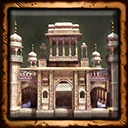 Karni Mata800Karni Mata1,2001,000Karni Mata2,0001,200Karni Mata4,0004,000
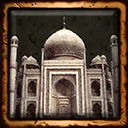 Taj Mahal800Taj Mahal1,2001,000Taj Mahal2,0001,200Taj Mahal4,0004,000
 Tower of Victory800Tower of Victory1,2001,000Tower of Victory2,0001,200Tower of Victory4,0004,000
Home City cards (150)
Every card of the Delhi Home City, by the first age it can be sent in. "×N" = can be sent N times; ∞ = no limit.
I Discovery Age (32)
 1 Grove Rickshaw +1 Villager×12 Pet Lions +1 Villager×12 Pet Tigers +1 Villager×1
 Advanced Dock×1
 Advanced Rice Paddy×1
 Advanced Wonders×1
 Bazaar×1
 Bombay Marine×1
 Chests of 300 Coin∞
 Cords of 300 Wood∞
 Crates of 300 Food∞
 Distributivism×1
 East Indiamen×1
 Enlist Irregulars×1
 Establish Ironmonger×1
 Exotic Hardwoods×1
 Farmland Conservation×1
 Favorable Karma×1
 Fish Market×1
 Food Silos×1
 Fur Trade×1
 Furrier×1
 Good Faith Agreements×1
 Goraksha×1
 Holy Refuge×1
 Pioneers×1
 Rum Distillery×1
 Sawmills×1
 TEAM Sumptuary Laws×1
 The Mystical Syllable×1
 Trade Empire×1
 Woodcrafting×1
II Colonial Age (44)
 1 Caravel∞
 1 Flatland Castle×1
 2 Caravels +1 Villager×12 Grove Rickshaws +1 Villager×1
 4 Sowars +1 Villager×1
 5 Rajputs +1 Villager×1
 5 Sepoys +1 Villager×1
 Admiralty×1
 Armed Fishermen×1
 Atonement×1
 Battlefield Construction×1
 Camel Attack×1
 Chests of 700 Coin +1 Villager×1Cords of 500 Wood∞
 Cords of 700 Wood +1 Villager×1
 Crates of 600 Food +1 Villager×1Crates of 700 Food +1 Villager×1
 Desert Terror×1
 Diplomatic Intrigue×1
 Dravidian Martial Arts×1
 European Cannons×1
 Extensive Fortifications×1
 Fencing School×1
 Foreign Logging×1
 Grazing×1Hire 10 Tiger Claws×1Hire 7 Chakrams×1
 Improved Warships×1
 Land Reforms×1
 Mughal Architecture×1
 Native Alliance×1
 Native Learning×1Recruit Maratha +10 Dacoit×1Recruit Maratha +6 Thuggee×1
 Rendering Plant×1
 Riding School×1
 Silversmith×1
 Spice Trade×1
 Sustainable Agriculture×1
 TEAM 2 Flail Elephants×1
 TEAM 2 Pet Rhinos×1
 TEAM Medicine×1
 The Raj×1
 Zamindars×1
III Fortress Age (37)
 1 Frigate +1 Villager×1
 1 Hill Castle×12 Howdahs +1 Villager×12 Mahout Lancers +1 Villager×12 Siege Elephants +1 Villager×13 Caravels +1 Villager×13 Flail Elephants +1 Villager×13 Mahout Lancers +1 Villager×1
 4 Stuart Allies×16 Sowars +1 Villager×1
 7 Gurkhas +1 Villager×17 Rajputs +1 Villager×1
 7 Urumi Swordsmen +1 Villager×18 Gurkhas +1 Villager×1
 8 Zamburaks +1 Villager×19 Sepoys +1 Villager×19 Zamburaks +1 Villager×1
 British East India Company×1Chests of 1,000 Coin +1 Villager×1Chests of 900 Coin +1 Villager×1Cords of 1,000 Wood +1 Villager×1Cords of 900 Wood∞Cords of 900 Wood +1 Villager×1Crates of 1,000 Food +1 Villager×1
 Dukkha Suffering×1
 Elephant Combat×1
 Foreign Trading Companies×1Hire Indian Arsonists×1
 Mercenary Loyalty×1
 Native Crafts×1
 Native Warrior Hitpoints×1
 Royal Green Jackets×1
 Royal Mint×1
 Tame Elephants×1
 TEAM Kalari×1
 TEAM Recruit Maratha +10 Thuggee×1Town Rickshaw +1 Villager×1
IV Industrial Age (37)
 1 Monitor∞11 Rajputs +1 Villager×112 Gurkhas +1 Villager×112 Sepoys +1 Villager×112 Zamburaks +1 Villager×113 Rajputs +1 Villager×114 Gurkhas +1 Villager×114 Sepoys +1 Villager×114 Zamburaks +1 Villager×12 Frigates +1 Villager×1
 2 Mysorean Rockets∞2 Town Rickshaws +1 Villager×1
 3 Howdahs∞3 Siege Elephants +1 Villager×14 Mahout Lancers +1 Villager×15 Flail Elephants +1 Villager×1
 9 Urumi Swordsmen∞Cords of 1,300 Wood∞Cords of 1,600 Wood +1 Villager×1
 Hire 11 Chakrams∞Hire 17 Chakrams×1Hire 25 Tiger Claws×1
 Hire 6 War Elephants∞
 Hire Indian Jat Lancers×1
 Hire Indian Mercenary Army×1
 Howdah Regiment×1
 Indian Gunpowder×1
 Mughal Elephant Armors×1
 Professional Handlers×1
 Recruit War Dhows×1
 Rocketeers×1
 Sepoy Resistance×1
 Sowar Regiment×1
 TEAM Hire 16 Tiger Claws×1
 TEAM Improved Buildings×1
 TEAM Shivaji's Tactics×1
 Urumi Swordsmen Regiment×1