Random map · AoE3: DE 100.19.18309
Honshu
Honshu is a random map in AoE3: Definitive Edition 100.19.18309, in the Asian Maps, Standard Maps, All Maps and Water Maps.
This section as JSON: /raw/maps.json
Quick answers (1)
- Is Honshu a competitive map?
- It is not in the game's Competitive map set; it is in the Asian Maps, Standard Maps, All Maps and Water Maps (AoE3: Definitive Edition 100.19.18309).
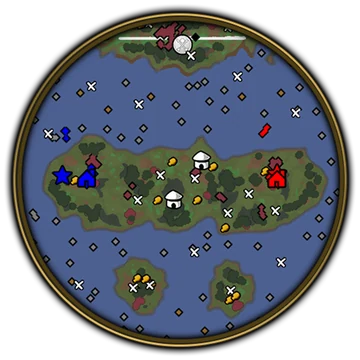
Honshu: A narrow strip of land is surrounded with islands, one of which features a tiny Trade Route.
Settlements: Zen, Jesuit
Outlaws: Wokou Horseman, Wokou Ronin
Players begin on either end of a long narrow island. Mines can be found on the smaller islands nearby. A larger landmass opposite the other coast features a tiny but pivotal Trade Route. The limited supply of Food on the main island will drive players to fish the rich coastal waters.
Native settlements
None listed in the map's files.
The settlements its script can place (a match uses some of them).
In the game's map sets
Has a large version for more players (honshuLarge).
History
Often referred to as the Japanese mainland or central Japan, Honshu is the largest of the four Japanese islands. It is 800 miles long and 150 miles wide. Honshu is a mountainous, volcanic region, with Mount Fuji, its highest point, soaring to an impressive peak of 12,389 feet. The mainland is separated from the island of Hokkaido by the Tsugaru Strait, from Kyushu by the Shimonoseki Strait, and from Shikoku by the Inland Sea. The climate of Honshu ranges geographically from snowy winters in the north to warm, subtropical temperatures in the south. While the products of agriculture are rich and varied - rice, cotton, fruits, and vegetables - Honshu is the source of two of Japan’s most famous resources: silk and tea. Its remote, heavily forested areas are teeming with monkeys, deer, boars, antelope, salamanders, snakes, and birds. In 1543, Portuguese sailors were the first Europeans to make contact with Japan, opening a limited trade relationship between the East and West. In 1549, St. Francis Xavier introduced Christianity to the island. After the death of Toyotomi Hideyoshi, the acting warrior dictator of Japan, Tokugawa Ieyasu claimed the title of shogun. His family would go on to rule Japan for 250 years. Domestic stability reigned during this period, but social progress was curtailed by a powerful central autocracy. Christianity was suppressed and commerce with foreign countries was prohibited. Only the Dutch retained the right to communicate with the Japanese from their single trading post on the island of Nagasaki.