Random map · AoE3: DE 100.19.18309
Silk Road
Silk Road is a random map in AoE3: Definitive Edition 100.19.18309, in the Asian Maps, Standard Maps, Land Maps, All Maps and Special Maps. Its script can place Tengri, Bhakti and Udasi settlements.
This section as JSON: /raw/maps.json
Quick answers (2)
- Which natives are on Silk Road in AoE3?
- Tengri, Bhakti and Udasi.
- Is Silk Road a competitive map?
- It is not in the game's Competitive map set; it is in the Asian Maps, Standard Maps, Land Maps, All Maps and Special Maps (AoE3: Definitive Edition 100.19.18309).
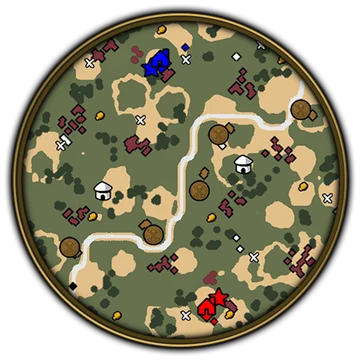
Silk Road: Travel the legendary trade route, capturing existing Trading Posts. You begin with a free Market.
Settlements: Bhakti, Shaolin, Sufi, Tengri, Udasi, Zen
Outlaws: Marathan Dacoit, Wokou Horseman, Wokou Monk, Wokou Ronin
Starting from their Markets at opposite sections of the famed Silk Road, players vie for control of this lucrative Trade Route. Since the map portrays a randomly selected part of the passage, three terrain variations are possible, each with unique characteristics. Players do not need to establish the route, only capture it before the enemy does!
Native settlements



The settlements its script can place (a match uses some of them).
In the game's map sets
Has a large version for more players (silkRoadLarge).
History
The Silk Road was a 4,000-mile caravan route beginning in Chang’an, China, and stretching west along the Great Wall of China, over the Pamir Mountains, across Afghanistan, and ending at the coast of the Mediterranean Sea. Used as early as 1000 BCE, the Silk Road was the most important pre-modern trade route in human history, providing merchants access to an extensive cultural and commercial network spanning China, central Asia, and Europe. Taking its name from early shipments of Chinese cloth, the road enabled a constant flow of goods, jade, gold, silver, wool, and spices from west to east, and inland to the sea. The Silk Road came about not from a desire for extensive trade, but when Chinese Emperor Wudi of the Han Dynasty sent a court representative to central Asia to seek allies in his campaign against warring Mongolian nomads who had besieged his empire. Unfortunately, the very Mongolian nomads he was hoping to subdue captured the court representative and imprisoned him for ten years. Upon his escape, he continued to central Asia to pursue his original goal, but success eluded him. Despite this, his journey west made the people of central Asia and the Chinese aware of each other. Soon the inhabitants of central Asia sought goods from China, and vice versa. Over its 1,500 years of use, the Silk Road route reached its heyday in the thirteenth century, when the Mongol conquests encouraged trade and travel between East and West. European artisans, ambassadors, missionaries, and merchants, including Marco Polo, ventured eastward as far as China, fostering the demand for Asian goods in the West. However, this interest in foreign trade ultimately led to the route’s decline. In the fifteenth century, European leaders began seeking a way to get from Europe to Asia by sea, and the discovery of South Africa’s Cape of Good Hope route rendered the Silk Road obsolete.