Cavalry · Colonial Age
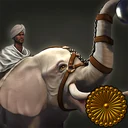
Mansabdar Flail Elephant
Mansabdar Flail Elephant (proto ID ypMercFlailiphantMansabdar) is a cavalry unit in AoE3: Definitive Edition 100.19.18309 from the Colonial Age: 650 hit points, melee 10 every 1.5 s (×4 vs Artillery, ×1.5 vs Infantry), 50% ranged resist. It costs 250 food, 250 coin and takes 43 s to train at the Charminar Gate. 1 civilization has it.
Quick answers (3)
- How much does Mansabdar Flail Elephant cost in AoE3?
- 250 food, 250 coin; 43 s to train; 3 population (AoE3: Definitive Edition 100.19.18309).
- Which civilizations have Mansabdar Flail Elephant?
- Indians.
- What is the proto ID of Mansabdar Flail Elephant?
- ypMercFlailiphantMansabdar — the name scenario triggers, AI scripts and mods use.
 250
250 250
250Inspires all nearby Flail Elephants. Powerful Elephant from India that swings a mace. Good against buildings.
- Population
- 3
- Line of sight
- 15
- Ranged resist
- 50%
- Build limit
- 1
- Available from
- IIColonial
- XP when killed
- 50
- Game ID
ypMercFlailiphantMansabdar
In the game's words
How to use it
The Mansabdar Flail Elephant is an Elite Indian unit that can be trained at the Charminar Gate Wonder. It has an inspiring affect on all nearby non-Mansabdar units of the same type, increasing their attack and hitpoints. The smallest of Indian elephant units is the Flail Elephant. While not as rugged or versatile as other elephant units, it is highly effective against buildings, making it a powerful siege weapon.
History
During his rule over the Mughal Empire of India, Akbar the Great brought the whole of his military organization under a new system of administration called the mansabdari. The title was taken from the term “mansab,” which means rank. Officers in the Mughal army were given a mansab and then expected to be servants of the state, with their dismissal or suspension resting directly in the hands of the emperor. There were thirty-three grades of mansabdars, differentiated by the Zat and the Sawar. The Zat referred to the number of troops that the mansabdar maintained, while the Sawar referred to the number of horses that he maintained. The number of soldiers under a man’s command could start at ten and rise into the ten thousands. Of course, the highest rank that any common officer could hold only offered a command of 5,000 men. Larger forces were always first allotted to royal princes. Yet, after the death of Akbar at the beginning of the seventeenth century, the grades were increased. Common officers could reach the mansabdar grade corresponding to a command of over 20,000 men. Although there are few accounts to substantiate its existence, the flail elephant was said to have been a cavalry and siege unit fielded with the early armies of Sri Lanka. It would enter battle whirling a heavy iron chain that had been affixed to its trunk, becoming both a terrifying and entirely unapproachable force.
From the game's History encyclopedia (Special).

Attacks
| Attack | Damage | Every | Range | Multipliers |
|---|---|---|---|---|
| Meleearea 2 | 10 melee | 1.5 s | — | ×4 vs Artillery×0.67 vs Heavy Infantry×1.5 vs Infantry |
| Siege | 80 siege | 1.5 s | — | — |
Trained at

Civilizations

Cards and technologies that change it
 Foreign Trading CompaniesFood cost +2%, Coin cost +2%
 Mughal Elephant Armorssiege resist +0.1
 Cavalry CuirassHeavy Cavalry: hit points +10%
 TEAM Cavalry AttackHeavy Cavalry: damage +10%TEAM Cavalry AttackHeavy Cavalry: damage +10%
 Somali Ajuran EngineersSiege Trooper: damage bonus against Frontier Fortification +20%
 WampumUnit: XP for building +35%, train time −20%; Siege Trooper: train time +15%
 BlandenguesHand Cavalry: Coin cost −20%, Wood cost −20%, Food cost −20%
 Hand Cavalry AttackHand Cavalry: damage +15%
 Hand Cavalry HitpointsHand Cavalry: hit points +15%
 Hand Infantry / Hand Cavalry HitpointsHand Cavalry: hit points +15%
 Junín HussarsHand Cavalry: train time −30%; Cavalry: speed +5%
 Morning StarHand Cavalry: damage bonus against Guardian +2
 PancerzHand Cavalry: ranged resist +0.1
 PillageHand Cavalry: damage bonus against Building +25%
 Plan of Casa MataHand Cavalry: speed +5%TEAM Hand Cavalry AttackHand Cavalry: damage +15%
 Crushing ForceElephant: damage (Melee) +15%, damage (Melee (defend)) +15%, damage (Trample) +15%
 Elephant CombatElephant: hit points +20%, damage +20%
 Tame ElephantsElephant: Coin cost −10%, Wood cost −10%, Food cost −10%, train time −10%
 Disciplined Flail ElephantMerc Flailiphant: damage +20%, hit points +20%
 Exalted Flail ElephantMerc Flailiphant: hit points +50%, damage +50%
 Honored Flail ElephantMerc Flailiphant: damage +30%, hit points +30%
 Professional HandlersMerc Flailiphant: population −1
 Cavalry CombatCavalry: hit points +15%, damage +15%Cavalry CombatCavalry: damage +15%, hit points +15%Cavalry CombatCavalry: hit points +15%, damage +15%Cavalry CombatCavalry: hit points +15%, damage +15%Cavalry CombatCavalry: hit points +15%, damage +15%Cavalry CombatCavalry: hit points +15%, damage +15%Cavalry CombatCavalry: hit points +15%, damage +15%Cavalry CombatCavalry: hit points +15%, damage +15%Cavalry CombatCavalry: hit points +15%, damage +15%Cavalry CombatCavalry: hit points +15%, damage +15%Cavalry DamageCavalry: damage +15%Cavalry DamageCavalry: damage +15%Cavalry HitpointsCavalry: hit points +15%Cavalry HitpointsCavalry: hit points +15%
 Cheyenne Horse TradingCavalry: train time −40%
…and 47 more that change every Heavy Cavalry.
Source: protoy.xml and techtreey.xml, AoE3: DE 100.19.18309 (build 25040513).