
Infantry · Colonial Age
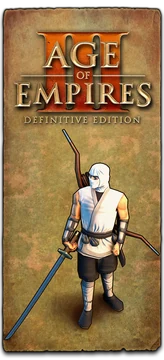
Shinobi-No-Mono
Shinobi-No-Mono (proto ID ypConsulateShinobi) is an infantry unit in AoE3: Definitive Edition 100.19.18309 from the Colonial Age: 150 hit points, ranged 20 every 3 s at range 14; melee 8 every 1.5 s, 20% ranged resist. 1 civilization has it.
Quick answers (2)
- Which civilizations have Shinobi-No-Mono?
- Japanese.
- What is the proto ID of Shinobi-No-Mono?
- ypConsulateShinobi — the name scenario triggers, AI scripts and mods use.
Stealthy ranged infantry. Good against infantry.
- Population
- 1
- Line of sight
- 18
- Ranged resist
- 20%
- Available from
- IIColonial
- XP when killed
- 12
- Game ID
ypConsulateShinobi
In the game's words
How to use it
The Shinobi is a Japanese stealth unit with strong ranged and siege attacks. The Shinobi can be trained at the Consulate using the Japanese Isolation feature.
History
Translated to mean “one skilled in the art of stealth,” shinobi were masters of the art of stealth, also known as ninjutsu. They were peasants of no social rank, but in possession of expert skills that were sought after by generals and feudal lords, and that often fetched high prices. Most shinobi acted as assassins or spies, gathering reconnaissance information that could turn the tide of battle. While most feudal daimyo and honorable samurai waged a moral war against the outlaw shinobi, it is believed that many of these high ranking warriors actually were shinobi, and simply kept up the ruse of hunting the outlaws in order to deflect suspicion from their own actions. Popular culture has grossly misrepresented the appearance of shinobi, and they are most often identified by a black suit that supposedly helped them blend into the darkness. However, shinobi most likely dressed in the typical peasant garb of fifteenth-century Japan: remnants of samurai armor, with perhaps the addition of a head covering, and a special piece of footwear called jika-tabi, which had a split-toe design that improved gripping and wall climbing and were virtually silent. The shinobi arsenal consisted of a variety of weapons and diversions, many of which utilized gunpowder. Smoke bombs, firecrackers, hand cannons, and even land mines were used to stun enemies, or to provide a moment of confusion that allowed the shinobi to escape. These gunpowder secrets were carefully guarded within the shinobi clan. Another form of trickery were the ashiaro, wooden pads that were carved to look like an animal's paw, or a child's foot, and could be worn to produce misleading footprints. The numbers of shinobi reached its peak in the centuries of war before the establishment of the Tokugawa shogunate and the beginning of the Edo Period in 1603. During the waning years of the shinobi and the samurai, writers recorded the techniques and weapons of these arts in technical manuals in order to keep the traditions alive. The most famous of these was the “Mansen Shukai", written in 1676 by ninjitsu master, Fujibayashi Samuji.
From the game's History encyclopedia (Infantry).
Attacks
| Attack | Damage | Every | Range | Multipliers |
|---|---|---|---|---|
| Ranged | 20 ranged | 3 s | 14 | — |
| Melee | 8 melee | 1.5 s | — | — |
| Siege | 20 siege | 3 s | — | — |
Trained at

Civilizations

Cards and technologies that change it
 Akan FontomfromInfantry: speed +5%, train time −20%
 BastimentoInfantry: train time −25%
 Conservative TacticsInfantry: damage +10%, hit points +10%
 CouriersInfantry: train time −45%
 Cree TanningInfantry: hit points +5%
 Dueling SchoolInfantry: train time −25%
 Fencing SchoolInfantry: train time −40%Fencing SchoolInfantry: train time −40%Fencing SchoolInfantry: train time −40%
 HualcanaInfantry: resist +0.05
 Infantry CombatInfantry: damage +15%, hit points +15%
 Infantry HitpointsInfantry: hit points +15%
 Liberation MarchInfantry: train time −35%, speed +5%Liberation MarchInfantry: train time −35%, speed +5%
 Matrakci SchoolInfantry: train time −30%
 Military DrummersInfantry: speed +10%
 Navajo WeavingInfantry: hit points +5%
 Piechota WybranieckaInfantry: train time −20%
 Pok Ta PokInfantry: speed +10%, train time −10%
 Quechuan DietInfantry: train time −15%
 Quechuan MountaineeringInfantry: speed +10%
 RansackInfantry: damage (Siege) +50%, damage (Mortar Building) +50%
 Royal Fencing SchoolInfantry: train time −40%Royal Fencing SchoolInfantry: train time −40%
 Somali Oryx Hide ShieldsInfantry: ranged resist +0.05
 Standing ArmyInfantry: train time −25%Standing ArmyInfantry: train time −25%
 TEAM Inca BridgesInfantry: speed +5%
 TEAM Infantry HitpointsInfantry: hit points +10%
 TEAM Yongle InfrastructureInfantry: speed +5%
 Tilly's DisciplineInfantry: speed +20%, Coin cost +10%, Food cost +10%, Wood cost +10%
 YogaInfantry: damage +5%
 ZamindarsInfantry: train time −20%
 Carib Garifuna DrumsArcher: damage bonus against Villager +1
 Carib Kasiri BeerArcher: damage +10%
 SarmatismArcher: range (Ranged) +1, range (Ranged (defend)) +1, range (Ranged (stagger)) +1, range (Bow) +1, line of sight +1
 Seminole BowyerArcher: damage +15%
 Tupi Poison Arrow FrogsArcher: damage +10%
…and 42 more that change every Infantry.
Source: protoy.xml and techtreey.xml, AoE3: DE 100.19.18309 (build 25040513).