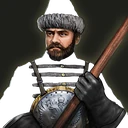
Infantry · Colonial Age
Poruchik
Poruchik (proto ID deRussianHalberdier) is an infantry unit in AoE3: Definitive Edition 100.19.18309 from the Colonial Age: 162.5 hit points, melee 22 every 1.5 s (×2 vs Cavalry, ×1.5 vs Light Infantry), 20% melee resist. It costs 70 food, 50 coin and takes 33 s to train at the Blockhouse, Fort, Galleon and 1 more. For the same resources it loses hardest to the Jaguar Prowl Knight (edge ×1.6) and beats the Hand Mortar hardest. 1 civilization has it.
Quick answers (5)
- What counters Poruchik in AoE3?
- For the same resources, Jaguar Prowl Knight (×1.6), Veteran Halberdier (×1.3), Desperado (×1.2) and Pistolero (×1.2) beat it hardest among regular units (base stats, AoE3: Definitive Edition 100.19.18309).
- What is Poruchik good against?
- For the same resources it beats Hand Mortar (×5.1), Culverin (×4.7), Organ Gun (×4.6) and Gatling Gun (×4.2) hardest.
- How much does Poruchik cost in AoE3?
- 70 food, 50 coin; 33 s to train; 1 population (AoE3: Definitive Edition 100.19.18309).
- Which civilizations have Poruchik?
- Russians.
- What is the proto ID of Poruchik?
- deRussianHalberdier — the name scenario triggers, AI scripts and mods use.
 70
70 50
50Russian junior officer. Heavy hand infantry with a large attack.
- Population
- 1
- Line of sight
- 12
- Melee resist
- 20%
- Available from
- IIColonial
- XP when killed
- 11
- Game ID
deRussianHalberdier
In the game's words
How to use it
The Poruchik is a unique Russian heavy hand infantry unit replacing the Halberdier. It is available starting in the Commerce Age and can be trained in groups of 4 in the Blockhouse. Like Halberdiers the Poruchiks are powerful hand infantry units with good hitpoints and damage. They are particularly effective against cavalry, but have enough base damage to be a threat to other types of units as well. Compared to a Halberdier the Poruchik is cheaper, but offers less hitpoints and damage in exchange.
History
The word “poruchik” is of Slavic origin and variably describes a person who receives orders or oversees something. In the Russian imperial army a Poruchik (“Lieutenant”) corresponds to a low company-grade or junior officer rank originally originating from the foreign mercenary regiments that were fighting for the Muscovite army. These mercenary regiments were often formed in German states and came with their own command structure which on its own had a lasting influence on the Muscovite and Imperial Russian armies. When emperor Peter the Great reformed the Russian army at the end of the 17th century he mostly sought to structure it after the Prussian model. In his “Table of Ranks” from 1722 he replaced most hereditary titles of nobility in the army and government institutions with new ranks. Many of these historical ranks such as Rittmeister (German for “Riding Master”), Fendrik (after German “Fähnrich”, a flag-bearer) or Stabs-Ofitser (after German “Stabsoffizier”, a senior officer) give testimony to this German influence. Whereas most officers in the Muscovite standing army were nobles officers in the reformed imperial army could also be commoners who proved their talent. In both armies the ranks of officers could be easily recognized by the colored tassels of their partisans, a polearm similar to a spontoon or halberd. A company-grade officer of rank such as the Poruchik would typically assume the command of 40 up to 100 soldiers. Greater military units like a Russian regiment (“polk”) featuring hundreds of soldiers was instead commanded by a polkovnik or brigadier, two ranks that already belong to superior rank group, the senior officers.
From the game's History encyclopedia (Infantry).

Attacks
| Attack | Damage | Every | Range | Multipliers |
|---|---|---|---|---|
| Melee | 22 melee | 1.5 s | — | ×2 vs Cavalry×1.5 vs Light Infantry |
| Siege | 30 siege | 3 s | — | — |
| Melee (cover) | 11 melee | 1.5 s | — | ×2 vs Cavalry×1.5 vs Light Infantry |
Counters, worked out
Armies of equal cost, base stats (no upgrades or cards). "Edge" = how many times the winner's spending the loser would need to draw.
Poruchik beats
 Hand Mortaredge ×5.1
 Culverinedge ×4.7
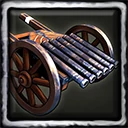 Organ Gunedge ×4.6
 Gatling Gunedge ×4.2
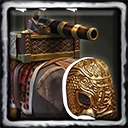 Siege Elephantedge ×3.9
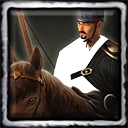 Yabusame Archeredge ×3.5
 Flail Elephantedge ×3.4
 Mahout Lanceredge ×3.2
Beats Poruchik
 Jaguar Prowl Knightedge ×1.6
 Veteran Halberdieredge ×1.3
 Desperadoedge ×1.2
 Pistoleroedge ×1.2
 Streletedge ×1.1
 Caroleanedge ×1.1
 Sentineledge ×1.1
 Soldadoedge ×1.1
How this is worked out
Each hit: damage × every multiplier that matches the target's types × (1 − the target's resist to that damage). Two ranged units trade shots; against a melee-only unit the better of ranged and melee is used. Damage per second = hit ÷ seconds between attacks.
Armies bought with the same resources fight by Lanchester's square law: strength = (resources ÷ unit cost)² × damage per second × hit points. The edge is the square root of the strength ratio. All matchups.
Trained at

Civilizations

Home City cards that ship it
Cards and technologies that change it
 Cudgel Wartime between attacks (Melee (cover)) −10%, time between attacks (Melee (defend)) −10%, time between attacks (Melee) −10%, speed +10%
 Guard Poruchikshit points +30%, damage +30%
 Imperial Poruchikshit points +50%, damage +50%
 New Order Regimentshit points +10%, damage +10%
 Pjotr's Toy Soldiershit points +15%, damage +15%
 Polkhit points +15%
 Sovnyadamage (Melee (defend)) +4, damage (Melee (cover)) +4, damage (Melee) +4
 Veteran Poruchikshit points +20%, damage +20%
 Archaic Infantry CombatHand Infantry: hit points +15%, damage +15%
 Archaic Infantry HitpointsHand Infantry: hit points +15%
 Carib Kasiri BeerHand Infantry: damage +10%
 Hand Infantry / Hand Cavalry HitpointsHand Infantry: hit points +15%
 Infantry BreastplateHand Infantry: hit points +10%
 Mapuche TacticsHand Infantry: damage (Siege) +50%
 Maya Cotton ArmorHand Infantry: hit points +20%
 Push of PikeHand Infantry: speed +10%, train time +10%
 TEAM Hand Infantry AttackHand Infantry: damage +15%
 Zapotec Cult of the DeadHand Infantry: damage +20%
 AcupunctureUnit: train time −25%
 Cult of the Supreme BeingUnit: XP for building +10%, XP for kills −10%
 Feudal ArmiesUnit: train time −15%
 Gadaa SystemUnit: hit points +5%, damage +5%
 Golden LibertyUnit: Coin cost −5%
 Mapuche Ad-mapuUnit: Coin cost −10%
 TEAM Shivaji's TacticsUnit: damage +5%, hit points +5%
 Torii GatesUnit: XP for building +60%
 Torii GatesUnit: XP for building +60%
 Torii GatesUnit: XP for building +60%
 Torii GatesUnit: XP for building +60%
 WampumUnit: XP for building +35%, train time −20%
 Western ReformsUnit: damage +8%, hit points +8%
 Winter CountsUnit: XP for building +40%
 Ignatian SpiritualityUnit Class: hit points +5%
 End RelationsMilitary: line of sight −7
 Ottoman AlliesMilitary: line of sight +7
 TEAM Spanish InquisitionMilitary: line of sight +10
 Town WatchMilitary: line of sight +3
 CorseletHeavy Infantry: hit points +25%, speed −15%
 TEAM House of BernadotteHeavy Infantry: hit points +15%
 United States ArmyHeavy Infantry: hit points +15%, damage +15%
 Akan FontomfromInfantry: speed +5%, train time −20%
 BastimentoInfantry: train time −25%
 Conservative TacticsInfantry: damage +10%, hit points +10%
 CouriersInfantry: train time −45%
 Dueling SchoolInfantry: train time −25%
…and 25 more that change every Hand Infantry.
Source: protoy.xml and techtreey.xml, AoE3: DE 100.19.18309 (build 25040513).