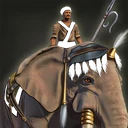
Cavalry · Fortress Age
Mahout Lancer
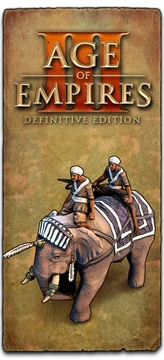
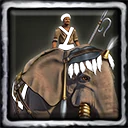
Mahout Lancer (proto ID ypMahout) is a cavalry unit in AoE3: Definitive Edition 100.19.18309 from the Fortress Age: 917 hit points, melee 28 every 1.5 s (×2 vs Infantry), 30% ranged resist. It costs 400 food, 250 wood and takes 60 s to train at the Fort and Caravanserai. For the same resources it loses hardest to the Puma Spearman (edge ×4.4) and beats the Gatling Gun hardest. 2 civilizations have it.
Quick answers (5)
- What counters Mahout Lancer in AoE3?
- For the same resources, Puma Spearman (×4.4), Qiang Pikeman (×4.3), Levied Spearman (×4.3) and Soldado (×4.1) beat it hardest among regular units (base stats, AoE3: Definitive Edition 100.19.18309).
- What is Mahout Lancer good against?
- For the same resources it beats Gatling Gun (×4.2), Culverin (×3.3), Organ Gun (×3.2) and Siege Elephant (×2.7) hardest.
- How much does Mahout Lancer cost in AoE3?
- 400 food, 250 wood; 60 s to train; 7 population (AoE3: Definitive Edition 100.19.18309).
- Which civilizations have Mahout Lancer?
- Ethiopians and Indians.
- What is the proto ID of Mahout Lancer?
- ypMahout — the name scenario triggers, AI scripts and mods use.
 400
400 250
250Heavy hand cavalry that inflicts wide-area damage. Exceptionally deadly against archers and skirmishers.
- Population
- 7
- Line of sight
- 15
- Ranged resist
- 30%
- Available from
- IIIFortress
- XP when killed
- 65
- Game ID
ypMahout
In the game's words
How to use it
The Mahout Lancer is an Indian melee cavalry unit that moves faster than any other elephant. It is extremely resilient, able to move in close to infantry and fight for long periods without depleting its high number of hitpoints. Its trample attack inflicts great area damage against infantry. The Mahout Lancer can be trained at a Caravanserai.
History
Mahout is the traditional name for one who trains and handles a domesticated elephant, a practice that has occurred for more than 3,000 years. In Hindu culture, elephants were highly respected as a manifestation of the elephant god Ganesh, the god of good luck. Having elephants participate in a festival or procession was required for every celebratory occasion, and being the mahout who cared for a great elephant on such an occasion was a great honor. Often considered the natural predecessor of the modern-day tank, the elephant brought many unique elements to its role as a battlefield unit. Early successes had more to do with surprise and intimidation than battlefield effectiveness. Enemy horses or camels, whether frightened by the beast’s smell, or overwhelmed by its sheer size, proved powerless against the elephant. It trampled oncoming waves of infantry and knocked riders from their mounts, scattering ranks and causing general confusion. It had a similar effect on the human enemy, terrifying many men to the point of panic. Yet, as armies became more accustomed to fighting elephants in battle, the methods of how to defeat them became evident. The most famous event involving a triumph over elephants occurred in 1398, when the Mongol conqueror Timur invaded India to overthrow the Delhi Sultanate. At a loss for how to fight back against the Indian’s elephants, Timur prayed to Allah for guidance. Then, according to legend, he attached straw to the backs of the camels in his army and sent them out to fight. When the camels neared the elephants, Timur had his men ignite the straw. The sight of the stampeding, flaming camels spooked the elephants so badly that they ended up crushing many Indian troops in their rush to escape.
From the game's History encyclopedia (Cavalry).
Attacks
| Attack | Damage | Every | Range | Multipliers |
|---|---|---|---|---|
| Meleearea 2 | 28 melee | 1.5 s | — | ×0.5 vs Heavy Infantry×2 vs Infantry |
| Siege | 100 siege | 3 s | — | — |
| Tramplearea 3 | 20 melee | 2 s | — | ×0.5 vs Heavy Infantry×2 vs Infantry |
Counters, worked out
Armies of equal cost, base stats (no upgrades or cards). "Edge" = how many times the winner's spending the loser would need to draw. This unit hits an area, so one-on-one figures understate it against groups.
Mahout Lancer beats
 Gatling Gunedge ×4.2
 Culverinedge ×3.3
 Organ Gunedge ×3.2
 Siege Elephantedge ×2.7
 Hand Mortaredge ×2.5
 Huaracaedge ×2.5
 Leather Cannonedge ×2.4
 Bersagliereedge ×2.2
Beats Mahout Lancer
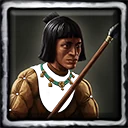 Puma Spearmanedge ×4.4
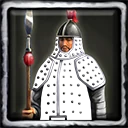 Qiang Pikemanedge ×4.3
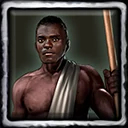 Levied Spearmanedge ×4.3
 Soldadoedge ×4.1
 Veteran Halberdieredge ×4
 Levied Gunneredge ×3.9
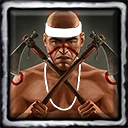 Tomahawkedge ×3.8
 Sentineledge ×3.8
How this is worked out
Each hit: damage × every multiplier that matches the target's types × (1 − the target's resist to that damage). Two ranged units trade shots; against a melee-only unit the better of ranged and melee is used. Damage per second = hit ÷ seconds between attacks.
Armies bought with the same resources fight by Lanchester's square law: strength = (resources ÷ unit cost)² × damage per second × hit points. The edge is the square root of the strength ratio. All matchups.
Trained at

Civilizations


Home City cards that ship it
Cards and technologies that change it
 Foreign Trading CompaniesFood cost +2%, Wood cost +2%
 Good Will AgreementsInfluence cost −15%, population −1
 Mughal Elephant Armorshand resist +0.1
 Cavalry CombatCavalry: hit points +15%, damage +15%Cavalry CombatCavalry: damage +15%, hit points +15%Cavalry CombatCavalry: hit points +15%, damage +15%Cavalry CombatCavalry: hit points +15%, damage +15%Cavalry CombatCavalry: hit points +15%, damage +15%Cavalry CombatCavalry: hit points +15%, damage +15%Cavalry CombatCavalry: hit points +15%, damage +15%Cavalry CombatCavalry: hit points +15%, damage +15%Cavalry CombatCavalry: hit points +15%, damage +15%Cavalry CombatCavalry: hit points +15%, damage +15%
 Cavalry DamageCavalry: damage +15%Cavalry DamageCavalry: damage +15%
 Cavalry HitpointsCavalry: hit points +15%Cavalry HitpointsCavalry: hit points +15%
 Cheyenne Horse TradingCavalry: train time −40%
 Comanche Horse BreedingCavalry: hit points +10%
 Comanche MustangsCavalry: speed +5%
 CouriersCavalry: train time −45%
 Cree TanningCavalry: hit points +5%
 Horse SecretsCavalry: speed +10%, train time −35%HorsemanshipCavalry: train time −33%, damage bonus against Walls +1
 Junín HussarsHand Cavalry: train time −30%; Cavalry: speed +5%Lakota Horse TradingCavalry: train time −25%
 Liberation MarchCavalry: train time −35%, speed +5%Liberation MarchCavalry: train time −35%, speed +5%
 Mass CavalryCavalry: train time −35%Mass CavalryCavalry: train time −35%
 Navajo WeavingCavalry: hit points +5%
 Polish HorsemanshipCavalry: train time −40%
 Quechuan DietCavalry: train time −15%
 Riding SchoolCavalry: train time −40%Riding SchoolCavalry: train time −40%Riding SchoolCavalry: train time −40%
 Shaman DrumsCavalry: train time −10%
 Spanish Riding SchoolCavalry: speed +10%
 Sudanese Quilted ArmorCavalry: hand resist +0.1
 TEAM Kamchatka ExpeditionsCavalry: line of sight +4, hit points +10%
 TEAM MustangsCavalry: Coin cost −10%, Wood cost −10%, Food cost −10%
 Terror ChargeCavalry: train time −20%
…and 46 more that change every Cavalry.
Source: protoy.xml and techtreey.xml, AoE3: DE 100.19.18309 (build 25040513).