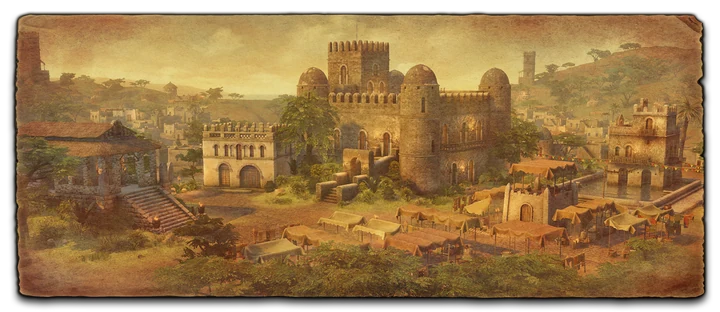

African civilization · Home City Gondar
Ethiopians
The Ethiopians (civ ID DEEthiopians, Home City Gondar) in AoE3: Definitive Edition 100.19.18309 start with 1 Zebu Cattle, 1 Livestock Market Builder, 1 Ras, 5 Villager and 3 Zebu Cattle, train 18 kinds of units from their own buildings and have 140 Home City cards. Their age-up choices number 5 / 6 / 7 / 8 for the Colonial, Fortress, Industrial and Imperial ages.
This section as JSON: /raw/civilizations.json
Quick answers (4)
- What are the Ethiopians bonuses in AoE3?
- Civilization bonus: Gets a free Mountain Monastery Builder with each Age-Up that can be built on top of Mines to gather Influence and Coin. Age-Up Alliances: (each grant extra bonuses) • Two new technologies at the Mountain Monastary • Units/Builders at the Palace or Town Center Unique Resource: Influence is a powerful resource spent primarily at the Palace on Native Warriors and Mercenaries. All unlocked features cost Influence. Generate it with Mountain Monasteries, Trading Posts and by controlling large herds of Livestock. Unique units: Sebastopol Mortar, Abun, Gascenya, Shotel Warrior, Neftenya and Oromo Warrior Placed on the “Roof of Africa” Ethiopia was able to assert its influence over the surrounding lowlands, thriving in the safety of its mountains. A high ground badly needed against hostile attempts to take the empire down. Ethiopia and its King of kings defied not just its African neighbors but also European colonization attempts rendering it as one of the few African regions that eluded the talons of European imperial colonialism.
- What do the Ethiopians start with?
- 1 Zebu Cattle, 1 Livestock Market Builder, 1 Ras, 5 Villager and 3 Zebu Cattle.
- Which Ethiopians age-up gives the most?
- to the Colonial Age: Habesha (≈ 300 resources); to the Fortress Age: Habesha (≈ 700 resources); to the Industrial Age: Habesha (≈ 1,000 resources); to the Imperial Age: Habesha (≈ 2,000 resources).
- How many Home City cards do the Ethiopians have?
- 140, plus 0 more in revolution decks.
Bonuses
Civilization bonus: Gets a free Mountain Monastery Builder with each Age-Up that can be built on top of Mines to gather Influence and Coin. Age-Up Alliances: (each grant extra bonuses) • Two new technologies at the Mountain Monastary • Units/Builders at the Palace or Town Center Unique Resource: Influence is a powerful resource spent primarily at the Palace on Native Warriors and Mercenaries. All unlocked features cost Influence. Generate it with Mountain Monasteries, Trading Posts and by controlling large herds of Livestock. Unique units: Sebastopol Mortar, Abun, Gascenya, Shotel Warrior, Neftenya and Oromo Warrior Placed on the “Roof of Africa” Ethiopia was able to assert its influence over the surrounding lowlands, thriving in the safety of its mountains. A high ground badly needed against hostile attempts to take the empire down. Ethiopia and its King of kings defied not just its African neighbors but also European colonization attempts rendering it as one of the few African regions that eluded the talons of European imperial colonialism.
The game's own civilization summary (civ picker rollover).
Starting units
- 1×
 Zebu Cattle
 - 1×
 Livestock Market Builder
 - 1×
 Ras
Ras - 5×
 Villager
 - 3× Zebu Cattle
Units few others have
Units Ethiopians train from their own buildings that no more than one other civilization has.

Age-up choices
What each choice costs and hands over, valued at the units' train cost. Compare every civilization's age-ups.
To the Colonial Age
 Habesha
 800gives ≈ 300
- Portuguese800gives ≈ 300
- Somalis800gives ≈ 300
- Sudanese800gives ≈ 300
- Jesuits800
To the Fortress Age

To the Industrial Age


History
While the recorded history of Ethiopia goes back several millennia, the region’s early modern history opens with a tumultuous conflict known to posterity as the Ethiopian-Adal War (1529-1543). The ruling Solomonic dynasty of Ethiopia struggled initially against the Adal forces of the intrepid Ahmad Gragn, whose deft use of Ottoman artillery gained him the upper hand in several battles. The Adal occupation lasted over a decade, but the Solomonic dynasty, led by the tenacious Queen Sabla Wengel and the formerly exiled Emperor Gelawdewos, eventually threw off the foreign yoke and defeated Gragn. Instrumental in this victory were the tattered remnants of a Portuguese expeditionary force led by Cristovao da Gama, who perished in the process. Gelawdewos then sought to turn the tables and invade Adal, but suffered the same fate as the overconfident Gragn and was slain in turn in 1559. Next to attempt to subjugate the resurgent Ethiopian state was the Ottoman Empire, which seized several key locations on the coast but was unable to push further inland. Further threats ensued from a new power: the Harar Sultanate, which had assumed control of the lands ruled by the crumbling Adal Sultanate. Although these were parried successfully, constant conflict and climatic conditions culminated in unstable conditions that caused a series of mass migrations of East African people-groups into the Ethiopian sphere of influence. Most notable among these were the Oromo, hardy pastoralists and fierce warriors who would attain immense power within the fragmenting Ethiopian state and retain it for centuries. By the late 17th century, Ethiopia had devolved into a patchwork of loosely knit localist entities that could only barely be said to answer to the imperial mantle. This all changed during the reign of Iyasu the Great (r. 1682-1706), who inaugurated a long programme of reforms across various spheres from political centralization to infrastructure, cultural growth, and foreign diplomacy. His untimely death, however, sent the recovering state into a tailspin. The resulting power vacuum was filled by a series of competing clans and princes, who by five decades later had reduced a once-powerful state into little more than an anarchical patchwork of feudal demesnes where ruthless warlords ruled by force. This so-called Era of the Princes lasted nearly a century. In 1855, Kassa Hailu, a shifta (brigand) turned magnate, triumphed over his rival warlords and was crowned Emperor Tewodros II. Desperate to modernize his fledgling nation, Tewodros resorted to the shocking decision to kidnap European officials and missionaries and barter them for help from European powers in industrializing Ethiopia. This scheme backfired violently, as the British responded with a full-scale invasion, annihilated Tewodros’ armies with ease, and rescued the hostages, leaving Ethiopia once more in a volatile situation. Despite this setback, the Ethiopian state recovered quickly. After the so-called Scramble for Africa commenced during the following decades, Ethiopia was notable as one of the few regions on the African continent that eluded the talons of European imperial colonialism.
From the game's History encyclopedia.
Units
Villager
Infantry
 Levied Bowman
 70
70 Gascenya70
 30
30 Levied Gunner90
 Neftenya65
 65
65 Desert Archer3075
 Desert Warrior3075
 Levied Spearman65
Cavalry
Artillery
 Sebastopol Mortar1,000
Ship
Other
 Surgeon225
 Shotel Warrior5550
Also available: 55 mercenaries, natives, pets and shipment-only units
 Caravel
 Covered Wagon
 Culverin
 Explorer's Dog
 Falconet
 Fishing Boat
 Li'l Bombard
 Mameluke
 Missionary
 Mortar
 Organ Gun
 Villager
 Uhlan
Uhlan AbunTrade Builder
 Kingdom Builder
 Camp Builder
 Native Embassy Travois
 Indian Market RickshawLivestock Market Builder
 Askari
 Cannoneer
 Gatling Camel
 Harquebusier
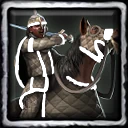 Sennar Horseman
 Mountain Monastery Builder
 Berber Camel Rider
 Somali Darood Militia
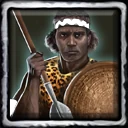 Somali Issa Warrior
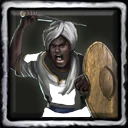 Sudanese DervishSomali Darood MilitiaSomali Issa WarriorSudanese DervishPalace Builder
 Aiz the Tame Elephant
 Nili the Playful Hippo
 Pambuu the Tame WarthogRasRas
 Red Sea WagonTrading Post Wagon
 Arsenal Wagon
 Indian Market Rickshaw
 Mosque Wagon
 Spy
Spy Arsenal Wagon
 Church Wagon
 Order Besteiro
 Fishing Boat
 Howdah
 Mahout Lancer
 ConquistadorConquistador
 War Elephant
 Old Doug the Orangutan
Buildings
 Gate50
 Factory400200
 Field Hospital200
 Fort500600Native Embassy100
 Town Center500
 Trading Post200
 Wall10Wall10Wall10
 Field50
 Granary—
 Hut100
 Livestock Market200
 Coal Mine—
 Copper Mine—Gold Mine—
 Silver Mine—Mountain Monastery150Palace200200
 Port200Diamond Mine—
 Torp140
 Watch Tower250Watch Tower—
 War Camp200
Home City cards (140)
Every card of the Gondar Home City, by the first age it can be sent in. "×N" = can be sent N times; ∞ = no limit.
I Discovery Age (30)
 4 Semi-fattened Cattle∞
 Advanced Agriculture×1
 Advanced Port×1
 Bushburning×1
 Charity×1
 Chests of 300 Coin∞
 Chitet×1
 Coffee Berries×1
 Cords of 300 Wood∞
 Crates of 300 Food∞
 Dejazmach×1
 Draft Oxen×1
 Era of Princes×1
 Establish Ironmonger×1
 Fish Market×1
 Furrier×1
 Hegemony×1
 Heywat Philosophy×1
 Indian Spice Trade×1
 King of Kings×1
 Oromo Migrations×1
 Pioneers×1
 Sawmills×1
 Shiftas×1
 Tabot×1
 TEAM 1 Camp Builder×1
 Temenyas×1
 Tokens of 300 Influence∞
 Trinity∞
 Warrior Nobility×1
II Colonial Age (36)
 1 Battle Canoe∞10 Desert Archers×110 Sudanese Allies×1
 2 Battle Canoes×1
 2 Camp Builders∞
 3 Abuns×13 Trade Builders×1
 4 Villagers×16 Berber Allies×1
 6 Gascenya×16 Jesuit Allies×16 Shotel Warriors×1
 Beekeepers×1
 Chests of 600 Coin×1Chests of 700 Coin×1
 Cords of 600 Wood×1Cords of 700 Wood×1
 Crates of 600 Food×1Crates of 700 Food×1
 European Cannons×1Fasilides' Castle×1
 Fazogli Gold×1
 Gascenya Damage×1
 Gascenya Hitpoints×1
 Hire Band of Cannoneer Mercenaries×1
 Improved Warships×1
 Jesuit Influence×1
 Lalibela Rock Church×1
 Mass Levies×1
 Medicine×1
 Prize Bull×2
 Rendering Plant×1
 TEAM Calpulli×1
 TEAM Trade Empire×1
 Tokens of 600 Influence×1Tokens of 700 Influence×1
III Fortress Age (39)
 1 Cannon Boat×1
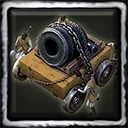 1 Sebastopol Mortar×11 Town Center Builder×111 Somali Allies×115 Sudanese Allies×1
 2 Oromo Warriors∞2 Palace Wagons×13 Battle Canoes×1
 4 Oromo Warriors×15 Abuns×1
 5 Neftenya∞
 6 Javelin Riders∞
 7 Neftenya×18 Gascenya×18 Jesuit Allies×18 Semi-fattened Cattle + 1 Livestock Market Builder∞8 Shotel Warriors×19 Gascenya×19 Shotel Warriors×1
 Balambaras×1
 British Firearms×1
 Canoe Crafting×1
 Cartridge Currency×1Chests of 1,000 Coin×1Cords of 1,000 Wood×1Crates of 1,000 Food×1
 Feudal Armies×1
 Hand Infantry Combat×1Hire Cannoneers×1Hire Sennar Horsemen×1
 Iyasu Reforms×1
 Land of the Sea×1
 Loyal Warriors×1
 Recruit War Dhow×1
 Sefari×1
 Shewa Riders×1
 Tigray Mekonnen×1Tokens of 1000 Influence×1
 Zebenyas×1
IV Industrial Age (35)
1 Cannon Boat + 1 Battle Canoe×1 1 Sebastopol Mortar×1
 10 Villagers∞
 12 Gascenya∞12 Neftenya×1
 14 Javelin Riders×115 Berber Allies×115 Shotel Warriors×116 Gascenya×12 Battle Canoes∞2 Sebastopol Mortars×122 Somali Allies×17 Oromo Warriors×1
 Advanced Arsenal×1
 Advanced Livestock Market×1Chests of 1,600 Coin×1
 Chewa Elites×1Cords of 1,200 Wood∞Crates of 1,600 Food×1
 Era of Chaos×1
 Ge'ez Script×1
 Gondarine Architecture×1
 Heavy Fortifications×1
 Hire Askaris×1
 Hire Gatling Camels×1
 Ignatian Spirituality×1
 Italian Firearms×1
 Karrayyu Pastoralism×1
 Native Treaties×1Recruit War Dhows×1
 Roof of Africa×1Royal Fortifications×1
 TEAM 1 Sebastopol Mortar×1
 TEAM Coffee Consumption×1Tokens of 1600 Influence×1