

European civilization · Home City Stockholm
Swedes
The Swedes (civ ID DESwedish, Home City Stockholm) in AoE3: Definitive Edition 100.19.18309 start with 1 Crates of Food, 3 Cords of Wood, 1 Explorer, 6 Settler and 1 Tiny Crate of Food, train 21 kinds of units from their own buildings and have 172 Home City cards. Their age-up choices number 5 / 5 / 5 / 5 for the Colonial, Fortress, Industrial and Imperial ages.
This section as JSON: /raw/civilizations.json
Quick answers (4)
- What are the Swedes bonuses in AoE3?
- Civilization bonus: Torps gather nearby resources. Jaeger and Black Rider mercenaries can always be recruited from the Tavern. Mercenary shipments are cheaper and arrive more quickly. Advanced improvements available at the Arsenal. Royal guard units: Pikeman (Dalkarl) and Hakkapelit (Drabant) Unique units: Carolean, Leather Cannon and Hakkapelit The Swedish Empire became one of the greatest in Europe through innovation in military tactics and logistics. Its artillery and cavalry charges dominated the battlefields, particularly during the Thirty Years War. Despite a relatively small population, the Swedes fielded some of the largest armies in Europe, partly through the recruitment of mercenaries.
- What do the Swedes start with?
- 1 Crates of Food, 3 Cords of Wood, 1 Explorer, 6 Settler and 1 Tiny Crate of Food.
- Which Swedes age-up gives the most?
- to the Colonial Age: The Naturalist (≈ 500 resources); to the Fortress Age: The Marksman (≈ 800 resources); to the Industrial Age: The King's Musketeer (≈ 1,000 resources); to the Imperial Age: El Presidente (≈ 2,000 resources).
- How many Home City cards do the Swedes have?
- 172, plus 65 more in revolution decks.
Bonuses
Civilization bonus: Torps gather nearby resources. Jaeger and Black Rider mercenaries can always be recruited from the Tavern. Mercenary shipments are cheaper and arrive more quickly. Advanced improvements available at the Arsenal. Royal guard units: Pikeman (Dalkarl) and Hakkapelit (Drabant) Unique units: Carolean, Leather Cannon and Hakkapelit The Swedish Empire became one of the greatest in Europe through innovation in military tactics and logistics. Its artillery and cavalry charges dominated the battlefields, particularly during the Thirty Years War. Despite a relatively small population, the Swedes fielded some of the largest armies in Europe, partly through the recruitment of mercenaries.
The game's own civilization summary (civ picker rollover).
Starting units
- 1×
 Crates of Food
 - 3×
 Cords of Wood
 - 1×
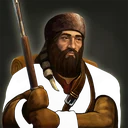 Explorer
 - 6×
 Settler
 - 1× Tiny Crate of Food
Units few others have
Units Swedes train from their own buildings that no more than one other civilization has.
Age-up choices
What each choice costs and hands over, valued at the units' train cost. Compare every civilization's age-ups.
To the Colonial Age
 The Naturalist
 800gives ≈ 500
- The Philosopher Prince800gives ≈ 500
- The Inventor800
- The Logistician900
- The Governor800
To the Fortress Age
 The Marksman1,200
 1,000gives ≈ 800
- The Gentleman Pirate1,2001,000gives ≈ 800
- The Mercenary Contractor1,2001,000
- The Bishop1,2001,000
- The Exiled Prince1,2001,000
To the Industrial Age
 The King's Musketeer2,0001,200gives ≈ 1,000
- The Engineer2,0001,200gives ≈ 1,000
- The Cavalry Marshal2,0001,200gives ≈ 950
- The Logistician2,0001,200
- The Papal Guard2,0001,200
To the Imperial Age
 El Presidente4,0004,000gives ≈ 2,000
- The Royalist4,0004,000gives ≈ 1,955
- The General4,0004,000gives ≈ 1,600
- The Knight4,0004,000
- The Mercenary Contractor4,0004,000
History
The early-modern Swedish state first emerged during the 16th century when, after decades of tension between the monarchy and nobility, Gustav I Vasa (1496-1560, r. 1523-1560) ascended to the throne. His greatest contribution to the state was emancipating it from mercantile domination at the hands of the Hanseatic League, a trading organization based in Germany that had essentially monopolized overseas trade in the Baltic and, to a lesser extent, the North Sea. Consequently, the Swedish peasantry flourished and the region entered a period of economic prosperity. This period of state formation coincided with the Protestant Reformation, which incited vitriolic and sinister tension between Protestants and Catholics. While temporarily suffering due to recurring violence accompanying the ebb and flow of Reformation and Counter-Reformation, Sweden was soon established as a Protestant state when Karl IX (r. 1604-1611) deposed his rival Sigismund III. From this point onward, Sweden became heavily involved in the politics and religious conflicts of the continent. Under Karl’s successor, Gustavus Adolphus (1594-1632; r. 1611-1632), Sweden entered a golden age. Despite ascending to the throne at age 16 and being saddled with three inherited wars, Gustavus managed to stabilize his realm, concluding several largely favorable treaties and implementing a series of political, economic, and social reforms to secure domestic welfare while his military reforms revolutionized the Swedish army and navy. The combination of mobile field artillery with mobile cavalry and aggressive, versatile infantry tactics made the Swedish army deadly in battle. When Gustavus intervened in the Thirty Years’ War, not only did he salvage the Protestant cause; he even managed to conquer much of the Holy Roman Empire before dying in battle in 1632. Over the following decades, Sweden’s success on the battlefield in Scandinavia and in continental Europe led to the establishment of the Swedish Empire. During this time, Swedish migrants attempted the settlement of Africa and the Americas, but with marginal success. Overextended to begin with, their overseas possessions were swiftly lost or sold, most notably New Sweden in the Delaware River Valley, which was seized by the Dutch by 1655. Temporary instability was resolved by the powerful monarchs Karl XI (r. 1660-1697) and Karl XII (r. 1697-1718), who revived an economy weary from decades of warfare and further reformed the Swedish military into the fearsome Carolean army, an elite and versatile military force that conducted several successful campaigns into Russia and Poland-Lithuania. Despite the catastrophic Great Famine of 1695-1697, Sweden continued to expand, but was halted in the early 18th century by a staunch Russian defense that utilized scorched earth tactics and the brutal Russian winter to deadly effect. The Swedish Empire subsequently lost control of most of its overseas possessions. In an effort to reassert its control over the western reaches of the Baltic Sea, Sweden allied itself with the anti-French coalition during the Napoleonic Wars, managing to seize control of Norway in 1814. This marked the end of Swedish expansionism, however, as neutrality was pursued thenceforth while Sweden endeavored to industrialize and modernize its economic and political structure. A notable byproduct of these processes was the mass emigration of Swedes to the United States of America, where citizens of Swedish ancestry still constitute a considerable minority of the population.
From the game's History encyclopedia.
Units
Villager
 Fishing Boat
 70Settler100
Infantry

Cavalry
 Hussar12080
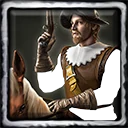 Hakkapelit90100
Artillery

Also available: 83 mercenaries, natives, pets and shipment-only units
 Bank Wagon
 Heavy Cannon
 Covered Wagon
 Mill Wagon
 DragoonExplorer
 Explorer's Dog
 Factory Wagon
 Fort Wagon
 Veteran Halberdier
 Black Rider
 Highlander
 Jaeger
 Landsknecht
 Mameluke
 Ronin
Ronin Swiss Pikeman
 Militiaman
 Carib Blowgunner
 Outpost Wagon
 Privateer
 Settler Wagon
 Skirmisher
 UhlanArtillery Foundry WagonDepot WagonFrontier Post Wagon
 General
 GunboatHomestead Wagon
 Grenadier
 Battleship
 Irish Brigadier
 Cranequinier
 Giant Grenadier
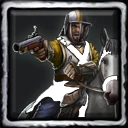 Harquebusier
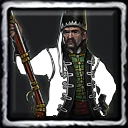 Pandour
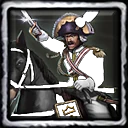 Royal Horseman
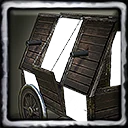 Fortified WagonMilitary Wagon
 Schiavone
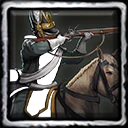 Chevauleger
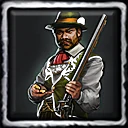 Mountain Trooper
 Sámi Noaidi
 Northern Musketeer
 Royal Arquebusier
 Royal Musketeer
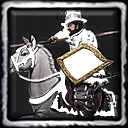 Shock Rider
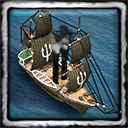 Whaling Ship
 Aiz the Tame Elephant
 Nili the Playful Hippo
 Sanura the Tame Leopard
 Pambuu the Tame WarthogEstate WagonProspector Wagon
 Quaker Gun
 High Master
 Knight Brother
 Order Musketeer
 Order Crossbowman
 Teutonic Knight
 Revolutionary Sharpshooter
 Regular
 Inquisitor
 State Militia
 Stealth PetardTorp WagonTrading Post Wagon
 Carbine Cavalry
 Advanced Hot Air Balloon
 Revolutionary
 Gatling Gun
 IroncladArsenal WagonBlockhouse Wagon
 CulverinUhlanMarket Rickshaw
 War Elephant
 Old Doug the OrangutanRepentant Black RiderRepentant JaegerRepentant Ronin
Buildings
 Arsenal250
 Artillery Foundry250
 Barracks200
 Gate50
 Capitol300
 Church150
 Dock200
 Factory400200
 Field Hospital200
 Fort500600
 Livestock Pen150
 Market100
 Mill400
 Outpost250
 Estate600
 Stable200
 Town Center500
 Trading Post200
 Wall10Wall10Wall10
 Coal Mine—
 Copper Mine—Gold Mine—
 Silver Mine—Diamond Mine—
 Tavern200
 Torp140Torp140
 Watch Tower—
Home City cards (172)
Every card of the Stockholm Home City, by the first age it can be sent in. "×N" = can be sent N times; ∞ = no limit.
I Discovery Age (38)
 1 Copper Mine∞
 2 Settlers∞3 Settlers×1
 7 Sheep + 1 Homestead Wagon∞
 Advanced Dock×1
 Advanced Estate×1
 Advanced Market×1
 Advanced Mill×1
 Advanced Trading Post×1
 Blueberries×1
 Chests of 300 Coin∞
 Colbertism×1
 Cords of 300 Wood∞
 Crates of 300 Food∞
 Duelist×1
 Establish Ironmonger×1
 Exotic Hardwoods×1
 Fish Market×1
 Furrier×1
 Hot Air Balloons×1
 Land Grab×1
 Master Surgeons×1
 Native Lore×1
 Oxenstierna Reforms×1
 Pioneers×1
 Ranching×1
 Rum Distillery×1
 Sawmills×1
 Schooners×1
 Stonemasons×1
 Surströmming∞
 TEAM Coastal Defenses×1
 TEAM Falun Mine×1
 TEAM Frugal Constructions×1
 TEAM House of Romanov×1
 TEAM New Sweden×1
 Town Militia×1
 Whale Oil×1
II Colonial Age (49)
 1 Caravel∞
 1 Galleon×1
 15 Elk×1
 2 Caravels×1
 2 Copper Mines×1
 2 Leather Cannons×1
 3 Hussars×1
 4 Surgeons×1
 5 Jagiellon Allies×1
 6 Spies×1
 7 Semi-fattened Cows×1
 7 Wittelsbach Allies∞
 8 Pikemen×1
 Admiralty×1
 Assassins×1
 Cavalry Damage×1
 Chests of 600 Coin×1Chests of 700 Coin×1
 Cigar Roller×1
 Contract Irish Brigadiers×1
 Contract Landsknechts×1
 Contract Royal Arquebusiers×1
 Cords of 600 Wood×1Cords of 700 Wood×1
 Crates of 400 Food, 400 Wood, and 400 Coin∞
 Crates of 600 Food×1Crates of 700 Food×1
 Dominions×1
 Engelsberg Ironworks×1
 Engineering School×1
 Extensive Fortifications×1
 Fencing School×1
 Frontier Defenses∞
 Hand Infantry / Hand Cavalry Hitpoints×1
 Hire Whaling Crew×1
 Improved Warships×1
 Julita Styckebruk×1
 March of the Hakkapelits×1
 Medicine×1
 Native Treaties×1
 Rendering Plant×1
 Riding School×1
 Silversmith×1
 Spice Trade×1
 TEAM 2 Surgeons×1
 TEAM House of Bernadotte×1
 Theaters×1
 Treaty of Roskilde×1
 Witch Hammer×1
III Fortress Age (48)
1 Covered Wagon×1 1 Frigate×1
 10 Pikemen∞10 Spies×112 Pikemen×1
 15 Sheep + 1 Homestead Wagon×117 Carib Allies×1
 2 Falconets×1
 2 Leather Cannons∞3 Copper Mines×13 Leather Cannons×1
 4 Hakkapelits×14 Hussars×1
 4 Sámi Allies×15 Hakkapelits×15 Hussars×1
 6 Grenadiers×1
 7 Wittelsbach Allies×1
 8 Caroleans×19 Caroleans×1
 Advanced Artillery×1
 Advanced Frontier Defenses×1
 Blackberries∞
 Case Shot×1Chests of 1,000 Coin×1
 Contract Black Riders×1
 Contract Giant Grenadiers×1
 Contract Hessian Jaegers×1
 Contract Swiss Pikemen×1Cords of 1,000 Wood×1Crates of 1,000 Food×1
 Dalecarlian Rebellion×1Fort×1
 Grenade Launchers×1
 Kalmar Castle×1
 Light Gun Carriages×1
 Line Grenadiers×1
 Mercenary Loyalty×1
 Native Warriors×1
 Naval Gunners×1
 Platoon Fire×1
 Ranged Cavalry Combat×1
 Recruit Privateer Fleet×1
 Refrigeration×1
 Royal Mint×1
 Snaplock×1
 Textile Mill×1
 Trample Tactics×1
IV Industrial Age (37)
 1 Battleship∞
 1 Falconet +1 Culverin∞
 1 Monitor∞
 10 Caroleans∞16 Caroleans×1
 2 Falconets +2 Culverins×12 Heavy Cannon×124 Pikemen×1
 25 Oldenburg Allies×1
 3 Horse Artillery×1
 3 Mortars×15 Leather Cannons×18 Hakkapelits×18 Hussars×1
 8 Wittelsbach Allies∞9 Grenadiers×1
 Advanced Balloon×1
 Allotment System×1
 Archipelago Fleet×1Baltic Fleet×1
 Castrametation×1Cords of 1,600 Wood×1Crates of 1,600 Food×1
 Cronstedt Reforms×1Factory×1
 Finnhorses×1
 German Mercenary Contracts×1
 Great Northern Forests×1
 Heavy Fortifications×1
 Hire Highland Mercenary Army∞
 Improved Buildings×1
 Industrial Revolution×1Osemund Process×1
 Svea Lifeguard×1
 TEAM 2 Mortars×1
 TEAM Gunboat Diplomacy×1
 Vasa×1
After a revolution: 65 cards of the revolution decks
 1 Fort Wagon
 12 Crossbowmen
 15 Elk
 16 Revolutionaries
 2 Fortified Wagons
 2 Ironclads
 25 Bourbon Allies
 4 Gatling Guns4 Prospector Wagons
 8 Hakkapelits
 Adler von LübeckAllotment System
 American Patriotism
 Armfelt's Autonomy
 Baltic CrusadeBaltic FleetBlackberries
 Blockhouse Cannon
 Bushnell's Continental SappersChests of 1,600 Coin
 Citizenship
 Continental ArmyCrates of 1,600 Food
 Cudgel War
 European Immigrants
 Fertile LowlandsFinnhorses
 Finnish Taiga
 Grand Duchy of Finland
 Gunboats
 Half-Brothers
 Haslet's Continental Regiment
 Hero of the Two Worlds
 Hire Cranequiniers
 Jaeger Combat
 Knighthood
 Knowlton's Continental Rangers
 Knox's Continental Artillery
 Kontors
 Land of Washington
 Lee's Continental Light Dragoons
 Lexington Minutemen
 Marion's Diversions
 Mercenary Camps
 Monastic Granges
 Morgan's Continental Sharpshooters
 Northern Wilderness
 Peerage
 Pennsylvania Long Rifles
 Powder Alarm
 Pułaski's Continental Cavalry
 Rhode Island Militia
 Riga Blackheads
 Savolax Jaegers
 Squires
 Steel Bolts
 Strelet Horde
 Suomenlinna
 Sword-Brothers
 TEAM Teutonic Town Center
 Teutonic Knights
 Teutonic Order Castles
 Trip To Jerusalem
 Turku Academy
 Washington's Continental Grenadiers